

In today’s world, different kinds of businesses have been producing a lot of data. The reports of sales, traffic to the web, communication with customers, results of marketing and figures in the field of finance contain very important pieces of information. However, data does not work alone. It is important to assemble the information in a proper way because raw data cannot produce results in itself.
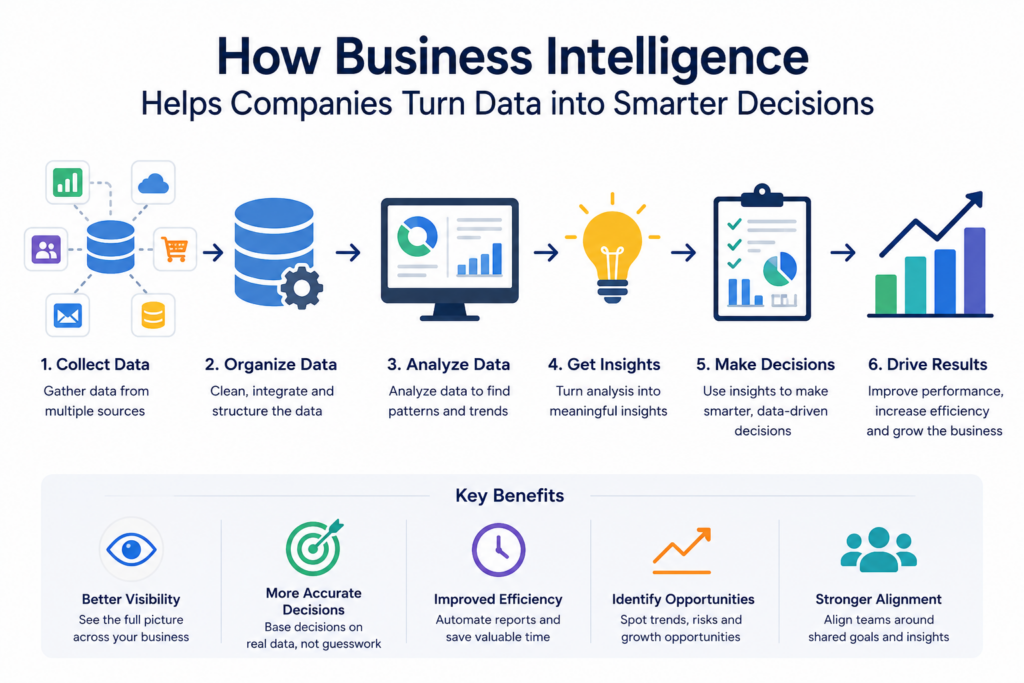
This is what Business Intelligence is doing in the contemporary world. Business Intelligence enables organizations to handle gathering, organizing, analyzing and visualizing the received data in order to make appropriate decisions. Thus, BI will allow the organizations to track their activities based on analytical data while avoiding to base their decisions upon only assumptions or free findings.
What Business Intelligence Does
Business Intelligence converts raw data into understandable and relevant insights. It gathers data from various sources such as CRM, ERP, accounting, marketing, and databases and presents it through means of analysis, reports, and visualization methodologies which make data interpretation easy and simple.
The main purpose of BI is to provide decision-makers with an accurate picture of what is going on in the organization.
Why Companies Need BI
A great deal of businesses these days already have sufficient information; however, organizations find it difficult to use their information properly. This is because different departments use different information management tools that lead to inconsistency in managing data. Businesses end up spending more time on data collection and less time analyzing data.
Business Intelligence technologies help organizations to resolve this issue by unifying the use of information. It makes information available in a single system.
The Role BI Plays in Enhancing Decision Making
Business intelligence takes the guesswork out of critical business decisions by providing useful data. This allows sales teams to find out what works and what does not, the marketing team to judge the efficacy of a marketing campaign, and finance guys to monitor profitability levels and expenditures with greater accuracy. Therefore, businesses are able to carry out their functions in a more smart and efficient way.
Improved Transparency and Efficiency
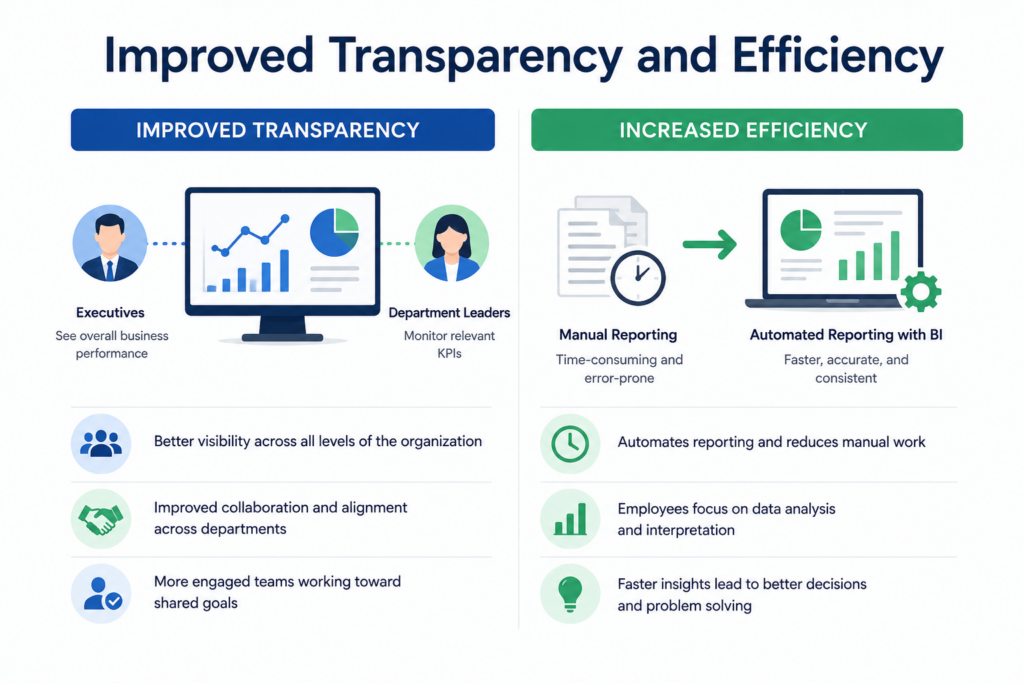
One of the major advantages that come with the use of BI is that it provides better transparency across firms. Executives will be able to see the general performance of the business, while department leaders will have the opportunity to monitor their most relevant KPIs. This allows its different divisions to work in a much better manner and be more engaged in their work in an organization.
Moreover, BI also greatly increases efficiency as it automates reporting making it less manual. Instead of having to fill in countless amounts of paper or spend hours helping in the form of preparing spreadsheets, employees will simply need to focus on the interpretation of data they have received from the BI system making it possible to solve different issues.
Seeing Opportunities in Consumer Behavior
BI enables organizations to turn raw data into valuable insights about industries, markets, and customers. Businesses need to know what is actually happening and what their audience is looking for and BI makes it possible. The technology can help organizations understand what is being purchased by consumers, which groups of consumers tend to buy certain products, or where the operational efficiencies exist.
Being able to analyze what consumers buy, why they buy it, and how often this happens, will assist businesses to enhance customer satisfaction, tailor communication with clients, and make more efficient choices concerning products and services.
BI for Long-Term Developments
Business Intelligence is useful not only for operational purposes but also for strategic decisions taken by companies. The information allowed executives and decision-makers to assess their progress and see how they perform in relation to their objectives. It is evident that in case a business has all the chances to get reliable information, it may use it for making efficient decisions concerning the future growth.
Conclusion
With the help of Business Intelligence, organizations are able to use data for rational decision-making by means of interpretation and understanding of data. This tool helps to see everything much better, make better predictions, be more efficient, and change along with the external environment. In a competitive market, success is not only about data collection, but also about understanding and using data in a proper way, often with the support of business intelligence consulting services.