
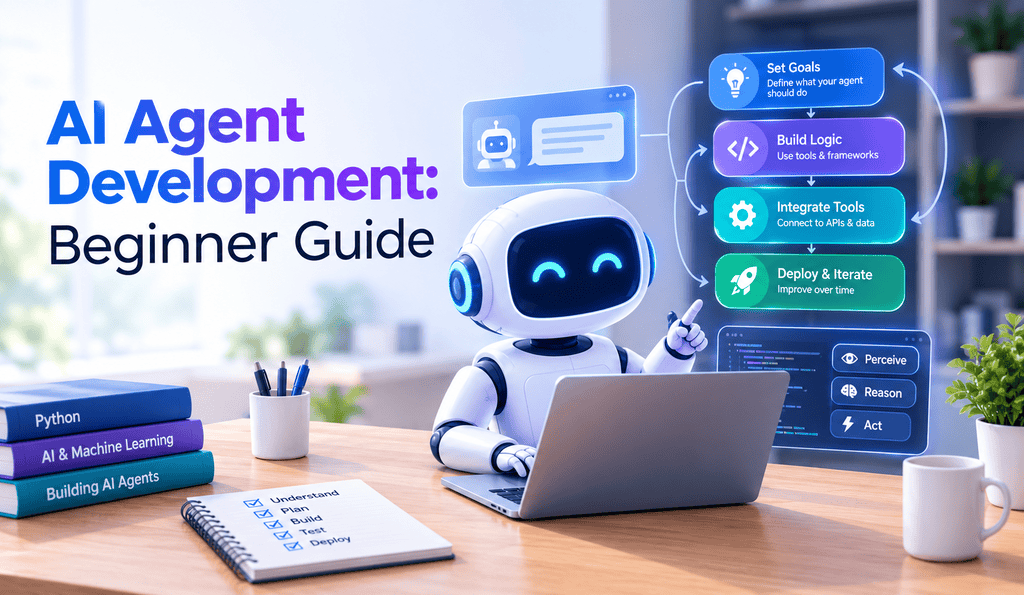
There are a ton of small, repetitive tasks that take up a lot of our time. Luckily, they aren’t hard. Unfortunately, they seem to come back again and again, and become tedious. Consider it an assistant that completes chores on your behalf. This helper only notifies you once the work is complete, and doesn’t distract you while doing the task. That helper is an AI agent.
The work of making such a helper is called AI agent development. More individuals are interested in learning more about this innovative technology.
For many years, AI development was mostly about one thing. People wanted computers to give good answers. You asked a question, the computer gave a reply, and then you had to do the rest yourself. An AI agent is different. It does more than just provide the solutions. It goes ahead and does the job too.
Read: How Interactive AV Tech is Revolutionizing Modern Training and Onboarding
Understanding AI Agent
An AI agent is a helper that can define its own path toward achieving a goal. You express your goals to it. It decides the steps.
This is a big change. Older AI tools only talked. You can let it know what you want done and let it take its time. Agents work much like assistants. The only difference is that agents, on their own, can take a step and decide what to do next based on the feedback they get from the environment.
But an agent is not magic. It can only do what its makers allow. The agent will not perform a task until it has a right to do so. In AI agent development, people spend a lot of time on this one point. What can the agent touch? What must it never touch? We will explain it again.
How AI Agent Development Is Different From Regular AI Development
An AI agent must have the ability to plan. It must break a large goal into smaller sub-goals and create a path from that to achieve the goal. It needs the ability to recall what it has already done so that it doesn’t repeat work. And it must be able to act. It must actually accomplish the task, not merely discuss it.
Because of all this, AI agent development needs more care than ordinary AI development.
The Main Parts That Make an AI Agent Work
It reads what you asked for. It then determines what ought to occur next. Every other part listens to it.
Next is the remembering part. A good agent keeps small notes while it works. On its own, the thinking part can only talk. In order to accomplish actual work, it hires some outside assistants. People doing AI agent development choose these helpers with care. They mostly keep the list short. Fewer helpers means fewer chances of a mess.
The last part is checking. After each step, the agent looks at what happened. Did the step work? Then it moves on.
Steps in AI Agent Development
It all starts here. The job must be small and clear. A big, loose goal makes a confused agent. People now have a lot of options because to years of AI development. Some are fast and cost less. Some are slower but better at hard questions. You don’t always need the most costly one.
After that, the agent is connected to the resources it requires to do its duties. Each link has limits. The agent may be able to see something but not change it.
Now the team writes the rules in plain words. When should the agent stop and call a person? How should it talk?
Testing takes the most time in AI agent development. The agent is asked several genuine questions by the team. Some are rude. Some are not clear. Some have spelling mistakes. Each time the agent slips, the team fixes it and tests once more.
Common Problems Beginners Face
The first surprise for beginners in AI agent development is that an agent can lose its way. On a long task, it may do one step twice. It may forget another step fully. Quick chores that are followed by a check are very beneficial.
Agents can also make things up. When the AI is not sure, it sometimes guesses. And it guesses in a very sure voice. This can cause real harm when someone needs a true answer. So many teams teach the agent to say “I am not sure” and pass the question to a person.
Cost is another surprise, even for people who have done AI development before. Each time the agent thinks, a small cost gets added. An agent that keeps thinking again and again for one small job can run up a big bill.
Conclusion
The concept underlying the AI agent development is simple to comprehend. Take the boring, repeat jobs off people’s hands. The world is not going to be taken over by robots. It’s about having an assistant do the tasks you don’t want to perform. Regular AI development gave us computers that answer well. AI agent development lets those computers act. But they act with care, and only inside limits that people set. Fix what goes wrong. Only then give it more work. The agents that last are not always the fanciest ones. Most of the time, they are the ones that were built slowly and tested well.