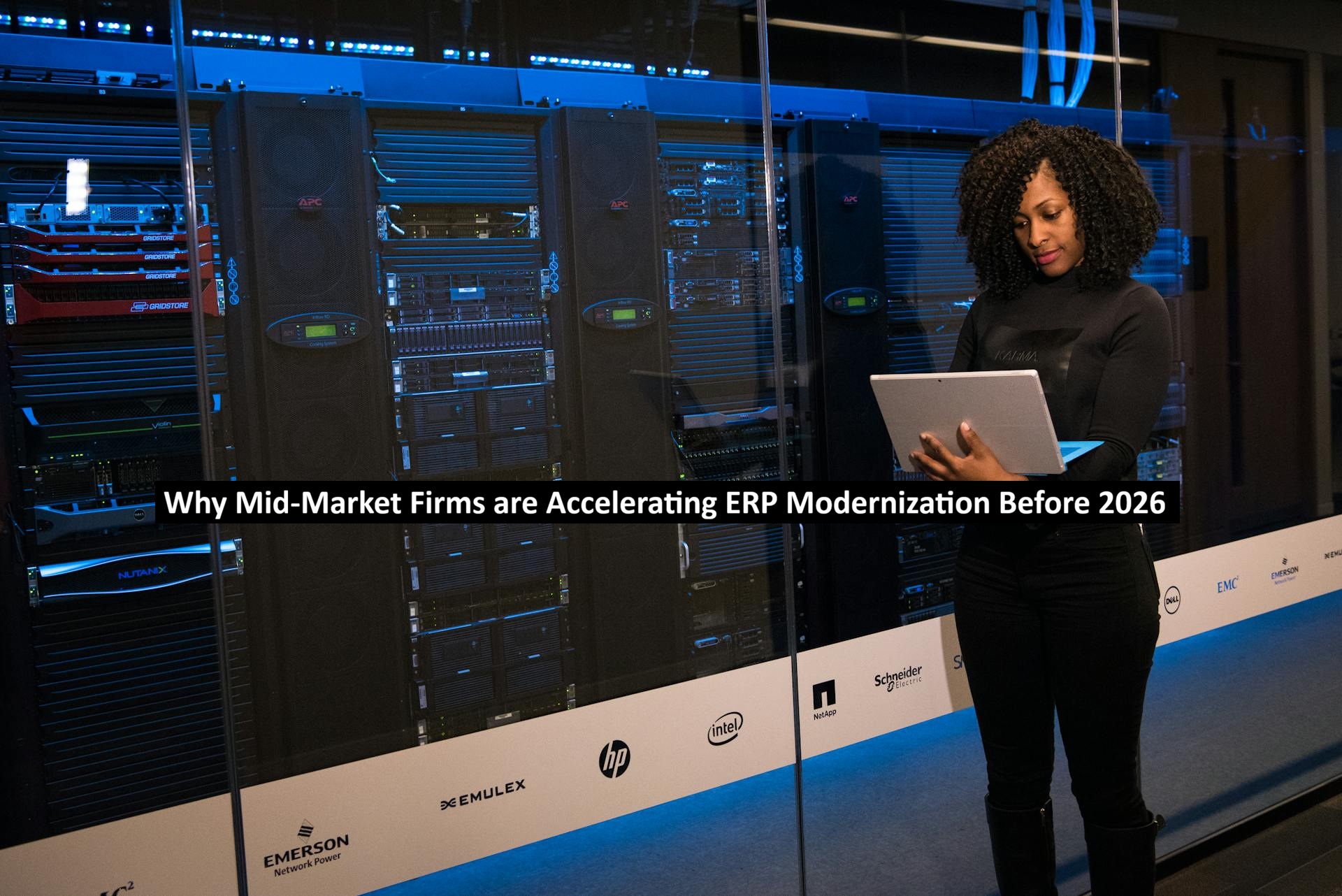
Mid-market companies often adopt a “make it work” mentality when it comes to their technology. Not so long ago, enterprise resource planning systems were a strictly large corporation play. It’s important to note, however, that the landscape is evolving rapidly. A perfect storm of technological innovation, regulatory requirements, and changing business models is forcing mid-market firms to upgrade their ERP systems, with 2026 a critical milestone.
The Limitations of Legacy ERPs
Many businesses operate on a patchwork of legacy systems and spreadsheets. While comfortingly familiar, these systems are increasingly a liability. One challenge is that disconnected data silos can impede information flow and offer little visibility into a comprehensive view.
Too often, departments export and manually import data. This cumbersome practice introduces errors and wastes precious time. Additionally, many older on-premises systems require regular upgrades, and the demand on IT teams to implement them can be overwhelming. Large capital expenditures are then deferred as time passes and risk is increased. This technical debt makes it very difficult to meet challenges or opportunities promptly.
Read: PPC Marketing for eCommerce: Driving Sales with Paid Ads
The Cloud Imperative

The rise of cloud-based ERP is a significant development and a game-changer, offering a clear path away from the problems of legacy systems. The market is currently seeing strong demand for cloud-native suites that lower infrastructure costs and provide real-time visibility.
Cloud ERP offers a subscription-based model, converting a significant capital expenditure into a predictable operating expense. This can allow mid-market firms access to the same powerful tools as their larger counterparts, but without the hefty price tag. Gartner predicts that end-user spending on cloud services will reach $723 billion by 2025.
What’s more, cloud ERP offers the agility and scalability that growing businesses need. A company can scale its ERP system as required, adding users and functionality without hassle. This is a far cry from the rigid, monolithic systems of old. Some companies are taking it even further and adopting a two-tier ERP strategy, where headquarters runs one system while subsidiaries run a more agile, cloud-based solution. This trend illustrates the flexibility of modern platforms.
The AI Revolution
Artificial intelligence is no longer the stuff of science fiction, but is fast becoming an integral part of today’s ERP systems. AI is being embedded directly into ERP software to handle a wide range of business processes.
For mid-market firms, this means a quantum leap for efficiency and decision-making. AI-powered ERPs can handle mundane tasks, allowing employees to focus on more strategic concerns.
The advantages extend far beyond simple automation. Predictive analytics can sift through historical trends to provide remarkably accurate estimates of what is likely to happen in the future. For example, a manufacturer can predict imminent equipment maintenance needs before mechanical failures occur, reducing downtime.
The distributor will be able to plan their inventory levels to comply with demand, minimizing carrying costs and the risk of stockouts. One of the most compelling drivers of ERP modernization is the shift from a passive, manual system to an active, intelligent partner.
New Regulations Coming
Regulatory mandates in many parts of the world are compressing the timeline for ERP system updates. Mandatory e-voicing laws that require businesses to use electronic invoicing are being implemented in many countries. There’s no imminent rule about this in the U.S. yet, but the EU is planning a mandate by 2028.
Many of these regulations require businesses to send invoices to tax authorities in a specified digital format. Companies with older ERP systems will likely find adhering to these new rules time-consuming and error-prone, which can lead to fines and payment delays. Compliance features in modern ERPs automate the process and ensure accuracy, reducing audit risk.
Of course, more accurate invoicing and tax payments are a big plus for companies, aside from regulatory requirements. However, in the coming years, governments will make it mandatory.
An Opportunity For Mid-Market Companies
For a long time, the mid-market has been stuck in limbo. Businesses have been forced to choose from a variety of separate solutions for functions such as accounting, HR, customer management, and more. Meanwhile, the cost and complexity of many ERPs made them viable mainly for enterprise companies with large budgets.
Fortunately, ERP providers are addressing this problem by offering solutions tailored to the needs of mid-market firms. The new generation of ERPs is built to be versatile, user-friendly, and easy to deploy. They boast the powerful functionality businesses need without the unnecessary complexity and expense.
Making a Smooth Transition

A transition of this sort is not only a matter of technology and money, but also of culture. One of the biggest challenges is breaking through employee resistance to new systems. It will only be successful if communication and training show how the latest technology will reduce tedious tasks and free up time and resources.
The time to act is now, as the cloud, AI, and new regulations are converging to create a clear imperative for mid-market firms to modernize their ERP systems.
In a business environment that requires agility and compliance, the “wait and see” approach is no longer tenable. By embracing modern ERP-based services, mid-market companies can streamline operations, cut costs, and unlock new opportunities for growth and innovation. 2026 looks to be a critical window to make this strategic investment and secure a competitive advantage.